
Electroless plating properties
The aesthetic appearance of Niplate coatings
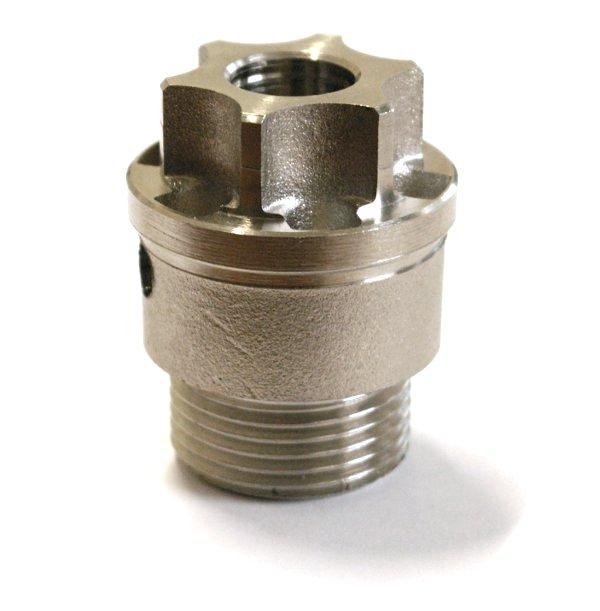
The aesthetic appearance of electroless nickel plating coatings is an intrinsic characteristic of the process and should be interpreted as a consequence of the deposition conditions and the condition of the base surface, rather than as a decorative objective of the treatment.
The NIPLATE® 500, NIPLATE® eXtreme, and NIPLATE® 600 coatings have a bright metallic appearance, comparable to stainless steel, with good long-term color stability thanks to the high oxidation resistance of the deposited nickel–phosphorus alloy.
Relationship between the base surface and the final appearance
Electroless nickel plating coatings have no leveling effect and faithfully reproduce the surface finish of the base material. As a result, the final appearance of the coated part depends directly on the material quality, the machining operations performed, and the pre-treatments carried out before nickel plating.
Surface defects such as scratches, porosity, oxidation, burrs, or machining marks are not masked by the coating and may become more visible after treatment. For applications where a uniform and controlled appearance is required, it is therefore necessary to act on the part surface beforehand.
Depending on the desired aesthetic result, mechanical pre-treatments may be used, such as:
- fine corundum sandblasting;
- shot peening with micro glass beads;
- metal shot blasting.
Color and brightness of traditional coatings
The NIPLATE® 500, NIPLATE® eXtreme, and NIPLATE® 600 coatings are characterized by a bright metallic white color, which remains stable over time under standard operating conditions. Brightness depends on light reflection from the surface and is closely related to the finish of the base material.
These coatings offer a good balance between functional performance and aesthetic appearance, making them suitable for applications where the visual appearance of the component plays a secondary, but not negligible, role.
Appearance of composite coatings
Composite coatings have a different color compared to traditional coatings, due to the presence of solid particles embedded in the electroless nickel matrix:
- NIPLATE® 500 PTFE: anthracite gray;
- NIPLATE® 600 SiC: matte light gray.
In these cases, the visual appearance is secondary to the coating function and is not a primary selection parameter.
Influence of heat treatments on appearance
Hardening heat treatments performed after electroless nickel plating may cause surface color variations. These variations are due to the formation of a thin nickel oxide layer, nanometric in thickness, which generates colors through optical interference phenomena.
Depending on the treatment temperature, the following may be observed:
- yellow coloration at temperatures above 260 °C;
- iridescent yellow–blue coloration at temperatures above 300 °C.
Where aesthetic appearance is a critical requirement, heat treatment can be carried out in a controlled or inert atmosphere, achieving the required hardness increase without altering the original color of the coating.
PRACTICAL RECOMMENDATIONS
- NIPLATE® coatings highlight, rather than hide, surface defects. Provide parts free of imperfections such as scratches, porosity, rust, oxidation, burrs, dents, oil, or grease.
- For a uniform matte finish, treatments such as shot peening with micro glass beads, fine corundum, or metal shot blasting can be used.
- Carefully evaluate the execution of the hardening treatment for components with stringent aesthetic requirements.
- Where combined hardness and aesthetic requirements apply, plan heat treatments in an inert atmosphere.